
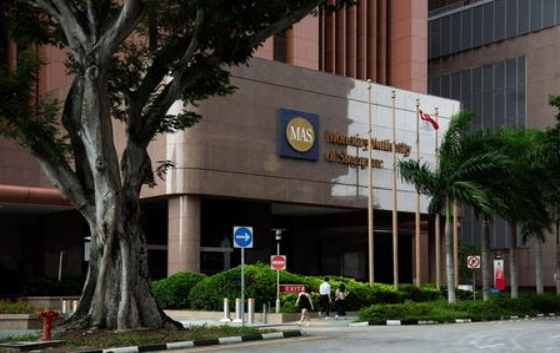
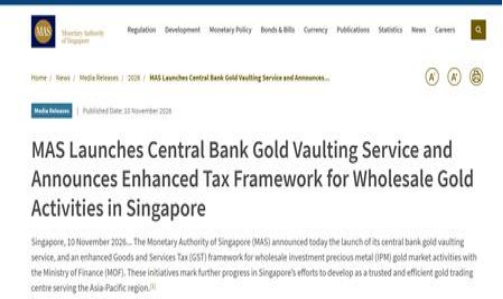
As global geopolitical uncertainty continues to mount, central banks worldwide are steadily increasing their gold holdings and promoting the diversification of their reserve asset allocations; consequently, a transformation is underway that is reshaping the global landscape of gold warehousing and custody. The Monetary Authority of Singapore (MAS) recently officially announced the launch of a central bank-level gold custody service for sovereign entities, including foreign central banks, multilateral international financial institutions, and sovereign funds. The initial national-level vault has a approved capacity of 500 tonnes and can be continuously expanded and upgraded in response to market demand. Unlike the commercial vault custody services commonly found in the market, this service is directly provided by the MAS with sovereign credit endorsement, making it one of the few infrastructure facilities globally where a national central bank accepts the storage of gold reserves from other sovereign institutions. For a long time, global central bank gold custody resources have been highly concentrated in traditional European and American hubs such as London and New York. Singapore's entry into this space is not merely about adding another safe; rather, it aims to use the Asian time zone as a pivot to create a precious metals hub capable of storing, trading, clearing, and activating sovereign gold assets, thereby providing global sovereign funds with a new Asian alternative.
I. Clarify the boundaries: central-bank-level sovereign custody is fundamentally different from ordinary commercial vaulting.
Many market participants may wonder: Singapore already possesses commercial vault capacity exceeding 2,000 tonnes, serving precious-metal banks, institutional capital, and high-net-worth clients; why, then, establish a separate national-level vault operated by the central bank and dedicated to sovereign institutions? The fundamental differences between the two lie primarily in three areas: the credit entities, entry thresholds, and regulatory standards. Commercial vaults are operated by market-oriented security and warehousing firms and serve commercial institutions and private capital, operating in accordance with commercial contracts; by contrast, the gold custody services introduced by the MAS rely on Singapore's national sovereign credit and impose strict service thresholds, limiting access to foreign central banks, sovereign funds, and multilateral international organizations. This constitutes an official "central bank-to-central-bank" custody service, and the providers of such services are extremely scarce worldwide. Monetary A...
A representative from the World Gold Council noted that, under the model in which a central bank directly assumes the custody of sovereign entities 'gold on behalf of the international market, market supply remains extremely limited; consequently, each newly established qualified custody facility alters the global gold warehousing landscape. At a press conference, Singapore's Deputy Prime Minister and Monetary Authority of Singapore (MAS) Chairman Yean Kim Yong made it clear that Singapore has no intention of replacing traditional gold custody centers in London or New York; instead, it aims to provide central banks worldwide with an additional option for decentralized storage. Against the backdrop of rising global uncertainty, central banks worldwide have generally recognized that concentrating all gold reserves in a single region entails multiple potential risks related to geopolitics, liquidity, and delivery; thus, the practice of maintaining gold reserves across multiple locations has become a consensus among an increasing number of countries. The press conference also revealed that, prior to the official announcement, several overseas central banks had proactively reached out to express their interest in storing their gold reserves in Singapore; however, due to confidentiality considerations, the MAS did not disclose the specific names of these institutions.
II. More Than Just a Gold Vault: Singapore Is Establishing a Complete "Warehousing — Account — Clearing" Closed Gold Loop
The 500-ton gold custody facility is merely the core driver of Singapore's gold strategy, not its entirety. MAS is simultaneously establishing a comprehensive, closed-loop gold industry ecosystem; its objective is not simply to provide "a safe for storing gold," but to create an Asian precious metals trading hub that enables asset liquidity. As early as June this year, at the Asia-Pacific Precious Metals Summit, Singapore announced four key directions for the development of gold: central bank-level gold custody, an over-the-counter gold clearing system, innovation in gold capital-market products, and the optimization of tax and fund frameworks related to precious metals. The implementation of this custody facility represents the first core infrastructure to be put into place within the overall strategy.
Under the supporting institutional arrangements, the MAS will make dedicated gold custody accounts available to qualified local precious metals banks in Singapore. Precious metals banks serve as hubs in the global gold wholesale market, connecting gold mining companies, central banks, asset management institutions, and derivatives traders; they are responsible for physical delivery, gold lending, leasing, hedging transactions, and other related services. With the support of the MAS's underlying gold vault accounts, these precious metals banks can provide direct liquidity services for the gold they custody. Consequently, gold held by central banks in Singapore will no longer be merely static reserve assets locked in vaults; it will also be available for pledging, interbank lending, and over-the-counter trading during Asian trading hours, thereby integrating the entire "warehousing — trading — clearing" chain.
Complementary tax policies are also being implemented in tandem. Starting in April of the following year, Singapore plans to expand the scope of consumption tax incentives for gold wholesale trading, incorporating gold warehousing, custody, and wholesale transactions into the incentive framework; this will reduce the overall costs for institutions conducting gold-related activities in Singapore and attract more gold wholesale transactions and physical deliveries to the city. In terms of competition among financial centers, taxation, regulation, liquidity, and warehousing infrastructure together form a comprehensive package for attracting capital; essentially, competition in the gold sector is a contest among entire financial ecosystems.

III. Restructuring the Landscape: Traditional gold custody centers are concentrated in Europe and the United States, leaving the time-zone disadvantage a long-standing issue.
Globally, the current arrangement for central bank gold custody has long been highly concentrated. The Bank of England is the world's largest central bank gold custodian, holding gold for more than half of all central banks worldwide; the Federal Reserve Bank of New York follows closely behind, while the central banks of Switzerland and France also undertake a portion of sovereign gold custody services. These traditional custody centers are concentrated in the time zones of Europe and the United States. This structure emerged during the gold standard era a century ago and was designed to align with the trading system of the London Bullion Market (LBMA); however, it inherently suffers from time-zone limitations: when Asian central banks seek to manage their gold reserves, arrange physical delivery, or conduct gold lending, they must coordinate with the trading hours of Europe and the United States. Consequently, during Asian daytime hours, the supply of sovereign gold liquidity remains relatively weak.
Singapore occupies a central position in Southeast Asia and covers the peak trading hours of Asia's key time zones, enabling it to fill the time-zone gap left by traditional gold hubs. For central banks in Asian countries, placing a portion of their gold reserves in Singapore means that verification, allocation, and trading can be completed during their own domestic business hours without having to wait across time zones, thereby significantly enhancing the dispatchability of their gold reserves. Combined with Singapore's open shipping and air logistics networks, the cross-border transport, warehousing, dispatch, and settlement of gold bars enjoy inherent advantages in terms of efficiency.
There is frequent discussion in the market regarding whether Singapore's push toward gold custody will create direct competition with the Hong Kong gold market. In an interview, Yan Jinyong specifically responded that the two are not in a zero-sum game. Hong Kong relies on its mature local spot gold market and its extensive retail and physical gold circulation infrastructure, whereas Singapore focuses primarily on central bank sovereign custody, wholesale clearing, and the institutional-grade gold derivatives sector. Because their positioning differs, the two can instead complement each other and jointly expand the overall scale of the Asian gold market. Asia is the region with the world's largest gold consumption and physical demand; for a long period in the past, Asia was responsible solely for consumption, while gold pricing, bulk custody, and clearing rules were long dominated by Europe and the United States. Singapore's current strategic positioning represents a significant step by Asian financial centers in attempting to gain influence over gold pricing.

IV. Capacity Analysis: What market significance does a first-phase capacity of 500 tonnes represent?
Let us perform a quick calculation to gain an intuitive understanding of what a 500-ton storage capacity represents. Based on current international gold prices, a 500-ton gold stock would correspond to an asset size in the tens of billions of dollars; for the reserves of a single national central bank, this would be sufficient to accommodate part of the gold diversification allocation of a medium-sized country. At the same time, the MAS has explicitly stated that 500 tons represents the initial capacity; if demand from sovereign institutions continues to rise in the future, the storage capacity can be expanded further. Combined with Singapore's existing 2,000-ton commercial gold warehouse, Singapore's overall gold storage capacity has reached approximately 2,500 tons, giving it a pronounced scale advantage in the Asian sovereign gold-storage market.
However, it must also be objectively recognized that a 500-ton sovereign gold vault would find it difficult to challenge the dominant position of London and New York in the short term. Traditional gold centers possess decades or even centuries of market conventions, mature LBMA delivery standards, an extensive market-maker network, and gold lending and derivatives liquidity pools; these ecosystem barriers cannot be rapidly dismantled by any single vault. London's commercial gold vault alone holds a gold inventory close to 10,000 tonnes; its market depth, trading activity, and market-maker ecosystem are unlikely to be surpassed in the short term.
Singapore's strategy is to proceed step by step: first, it seeks to establish itself as a "second custodian" that meets the demand of central banks for diversified asset allocation, rather than directly replacing existing custodian centers. For the logic underlying global central bank reserve management, the principle "do not put all your eggs in one basket" has evolved from an investment philosophy into a practical guideline for reserve management. Over the past few years, central banks in multiple countries have continuously increased their gold holdings while accelerating the return of gold to their home jurisdictions and the establishment of off-site storage facilities, thereby reducing the geopolitical risks associated with relying on a single custodian location. In this context, any newly established custodian location that enjoys reliable sovereign creditworthiness, neutral regulation, and robust security will attract a stable pool of potential clients. Singapore has precisely timed itself to capitalize on the current window of opportunity for central banks' gold diversification.
V. Spillover Effects: Gold Infrastructure Boosts the Overall Competitiveness of Singapore's Asset Management Ecosystem
The rise of the gold market will also, in turn, enhance Singapore's overall competitiveness in asset management, wealth management, and commodity finance. The precious metals business chain is extensive: from the receipt of gold bars into storage, quality inspection, registration, custody, reconciliation, leasing, pledging, over-the-counter trading, and ETF issuance, each stage drives the establishment of precious metals banks, law firms, auditing firms, security services, and asset management institutions. As more sovereign funds and large precious metals institutions establish gold businesses in Singapore, capital, talent, and trading volume will naturally spill over into other asset classes, further strengthening Singapore's appeal as a global asset haven and cross-border asset management hub.
Compared with other financial sectors in Singapore, VCC funds, family offices, stablecoins, and asset tokenization primarily target fund managers, high-net-worth individuals, and technology-based financial institutions; by contrast, gold sovereign custody connects directly with central banks worldwide, representing the highest level of official financial cooperation. This can significantly enhance Singapore's credibility within the circles of monetary authorities across various countries; the resulting sovereign credit dividend will extend to broader areas, including foreign exchange reserves, bilateral financial cooperation, and cross-border clearing. This is also why Singapore is willing to invest resources in establishing a national gold vault; its value extends far beyond the mere storage service fee.
For Singapore, the gold-track sector serves as a differentiated financial calling card. In an era of increasingly fierce competition among global financial centers, many cities are vying for positions in the family offices, funds, and crypto finance sectors; however, gold custody by a sovereign central bank entails extremely high entry thresholds and high trust costs. Once a reputation has been established, the resulting long-term moat is exceptionally robust.

VI. Practical Challenges: Trust, liquidity, and the audit framework—three major hurdles yet to be overcome
Behind the opportunities lie equally significant practical challenges. First, sovereign gold custody imposes extremely stringent standards regarding confidentiality, auditing, reconciliation, and physical verification. The MAS therefore needs to establish a set of internal control, inventory, and third-party auditing mechanisms that are aligned with international practices and recognized by central banks worldwide; the risk tolerance of sovereign institutions is far lower than that of commercial clients. The inventorying, spot checks, ownership segregation, and emergency transfer procedures for central bank gold reserves all require a prolonged period of adjustment and validation before they can earn the trust of monetary authorities in various countries.
Second, building gold liquidity cannot be achieved overnight. Even if a gold vault is established, if there are insufficient market makers and gold lending remains inactive, gold can only be stored passively, making it difficult to establish a trading hub. Pure warehousing services can only charge storage fees; only when gold lending, forwards, swaps, and over-the-counter derivatives markets become active can they genuinely attract sovereign institutions to keep their gold on-site rather than treating the facility merely as a remote backup repository.
Third, international competition continues to intensify. Other financial centers within the region are also steadily improving their gold infrastructure; Switzerland, Dubai, and Hong Kong are all continuously refining their policies related to precious metals, which will further intensify competition in this sector. For Singapore to achieve a breakthrough, it cannot rely solely on its physical gold infrastructure; it must also continue to strengthen its clearing systems, product innovation, and talent support.
VII. Asian Perspective: What lessons can be drawn for domestic cross-border institutions and precious metals market participants?
From the perspective of Asian financial markets, Singapore's intensified focus on the gold sector offers valuable insights for domestic institutions and cross-border investors. On the one hand, the infrastructure for the custody and clearing of physical gold assets in Asia continues to improve; consequently, the supply of gold ETFs, physical gold funds, and gold-linked structured products based in Singapore is expected to grow further, providing new investment vehicles for cross-border asset allocation. On the other hand, gold's pricing power and trading rules are undergoing a gradual restructuring; the influence of gold prices during Asian trading hours is likely to increase as physical warehousing and trading activities become more concentrated.
For domestic institutions engaged in cross-border commodity and precious metals trading, the maturation of Singapore's gold ecosystem will also provide a new hub for cross-border physical delivery and interbank cooperation. In the future, domestic precious metals banks, mining enterprises, and asset management institutions can leverage Singapore's gold clearing and custody infrastructure to conduct cross-border gold businesses and integrate the circulation chain for physical gold across Asia. At the same time, however, it should be noted that the threshold for sovereign custody services is extremely high; ordinary commercial institutions and private capital cannot directly access the central bank's gold reserves managed by the MAS. The core beneficiaries of this system remain the monetary authorities and sovereign entities of various countries, and it remains strictly distinct from market-oriented commercial gold pools.
For the domestic precious metals industry, Singapore's strategic positioning offers a useful reference: competition in the gold market ultimately hinges on institutional trust, cross-border liquidity, and supporting clearing and tax systems, rather than merely on the physical trading of gold.

VIII. Conclusion: The 500-ton vault is not the destination; it is the starting point for the development of Asia's gold hub.
The launch of the 500-ton national-level gold vault marks a milestone in Singapore's strategy to establish itself as a global precious metals hub. It is not a short-term, marketing-driven policy, but rather the starting point for a long-term financial infrastructure initiative: using sovereign gold custody as a lever to drive over-the-counter gold clearing, wholesale tax incentives, and innovation in capital-market products, thereby gradually building a gold ecosystem rooted in the Asian time zone and oriented toward central banks worldwide. In the short term, it provides global central banks with a completely new option for decentralized storage; in the medium to long term, it will extend the Asian gold market from the demand side to the upstream core segments of warehousing, custody, pricing, and clearing, thereby transforming the long-standing global gold landscape dominated by Europe and the United States.
At the conclusion of the press conference, Yan Jinyong noted that the value of gold is rooted in trust. Singapore's introduction of central bank-level gold custody essentially serves to export Singapore's institutional trust: a neutral and stable governance environment, predictable regulatory rules, and the credibility of an independent sovereign financial institution. As the global reserve system continues to undergo transformation and the trend toward de-singularity gains momentum, trust itself has become a scarce financial asset.
Over the next one to two years, the market will focus on two key areas: first, whether a number of central banks in emerging markets will formally launch gold custody services in Singapore, thereby testing market acceptance; and second, when Singapore's over-the-counter gold clearing system will go live and whether it can convert the existing gold held in custody into continuously active trading liquidity. If both developments proceed smoothly, Singapore is expected to grow into an Asian sovereign gold center that complements London and New York within a few years; meanwhile, breakthroughs in the gold market will serve as another trump card for Singapore in further consolidating its position as a global top-tier financial cen

 Home
 Message
 Phone