
With the continuous development of ASEAN capital markets, the Malaysian stock market has garnered increasing attention from overseas investors. The FTSE Kuala Lumpur Composite Index, serving as a key market benchmark in Southeast Asia, encompasses a wide range of sector-specific assets—including palm oil, semiconductors, consumer goods, and new energy—prompting many domestic investors to consider incorporating the Malaysian stock market into their asset allocation strategies. However, the trading mechanisms, account systems, and fee structures of Bursa Malaysia differ significantly from those of A-shares and Hong Kong stocks; directly applying trading practices from other markets could easily lead to operational errors, inaccurate cost estimates, or even avoidable losses. For novice investors entering the Malaysian market, thoroughly understanding the underlying trading rules prior to allocating capital is far more critical than analyzing individual stock performance. This article will examine the core trading rules of Bursa Malaysia from three perspectives—account systems, trading operational mechanisms, and trading costs and risk considerations—aiming to equip investors with a comprehensive understanding to participate in the Malaysian stock market in a rational manner. This article serves solely as an educational overview of market rules and does not constitute any investment advice. The stock market involves risks; investors should exercise caution before entering the market.

I. MAEX Account Opening Framework: Dual-Account Model Featuring CDS and Trading Accounts
To participate in the Malaysian stock market, the first step is to understand Malaysia's unique dual-account system—a concept that is most frequently misunderstood by overseas novice investors. In other markets, investors can complete all transactions by opening a single securities account; however, in Malaysia, you must hold both a brokerage trading account and a CDS Central Depository Account—both of which are essential.
CDS stands for Central Depository System; it functions as a depository account for stocks, where all purchased shares are registered under the name of the CDS account and are centrally held by the depository institution of the stock exchange. The shares are not held within the brokerage account. Regardless of which securities broker an investor switches to, the CDS account number remains unchanged, ensuring that the investor's stock assets remain unaffected by such a switch. Local residents in Malaysia may open an account using their identity card, whereas foreign investors must provide a valid passport for identity verification; they must also be at least 18 years of age to be eligible to open an account. Please note that electronic account opening via the official Bursa Anywhere app is currently only available to local residents in Malaysia; foreign investors generally need to submit required documents, including their passport, through offline or online remote channels of their securities broker to complete their CDS account opening application.
A trading account is provided by a licensed securities broker and serves as an operational account for placing orders, transferring funds, and reviewing trading profits and losses. In simple terms, the trading account handles order placement, while the CDS account manages the custody of your securities. Funds are held in a bank account linked to the broker; once a trade is executed, the securities are transferred to the CDS account, and the corresponding funds are settled in accordance with the T+2 rule.
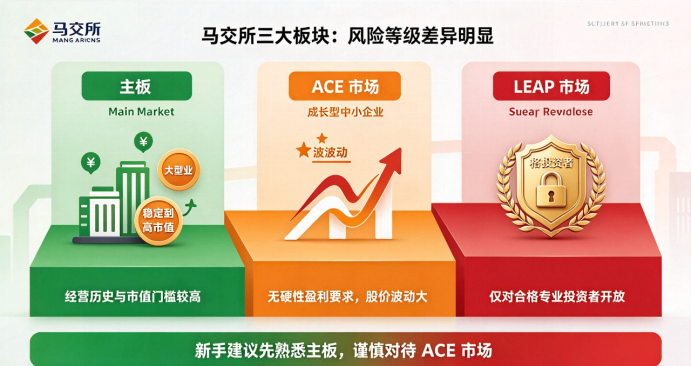
The Malaysian Stock Exchange (MSE) is divided into three main segments: the Main Market, the ACE Market, and the LEAP Market. Each segment targets a distinct category of enterprises, with significant differences in risk profiles. The Main Market requires companies to meet stringent criteria—such as a substantial operating history, profitability, and market capitalization—resulting in greater overall stability; the ACE Market imposes no mandatory profitability requirements, primarily catering to growth-oriented small and medium-sized enterprises, but is characterized by high stock price volatility, necessitating greater caution from retail investors; the LEAP Market is exclusively accessible to qualified professional investors, and ordinary individual investors are ineligible to participate in this segment. For novice investors, it is recommended to begin by familiarizing themselves with the market through instruments in the Main Market, while exercising prudence when investing in low-priced small-cap stocks within the ACE Market. Overseas investors have no specific quota restrictions when investing in the Malaysian stock market; funds can be remitted into the country, and dividends or proceeds from share sales may also be remitted abroad, provided that they comply with the foreign exchange regulations of the Bank Negara Malaysia. It is advisable to familiarize oneself in advance with the remittance procedures and the potential impacts of exchange rate fluctuations.
II. Core Trading Operating Rules: Trading Hours, Trading Units, and Settlement Regime
Once you have become familiar with the account, you should also grasp the actual trading rules of the market. The trading hours of the stock exchange, the T+0 trading and T+2 settlement mechanisms, the number of shares per lot, the quote brackets, and the price fluctuation limits all differ significantly from those of A-shares.
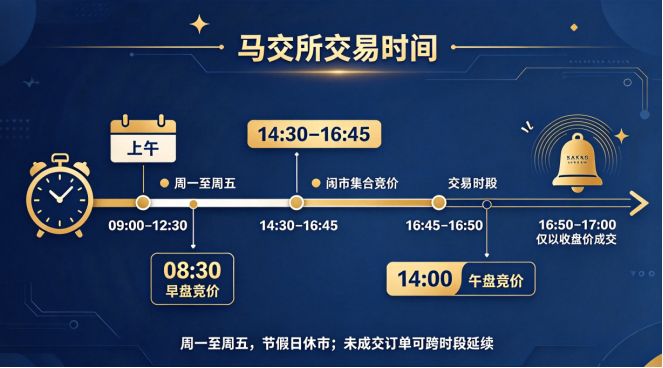
The trading days of the Malaysia Stock Exchange are Monday to Friday, operating under the Malaysia Time Zone (GMT+8), which aligns with Beijing Time; the exchange remains closed on public holidays. The market is divided into two trading sessions: the morning session from 09:00 to 12:30, and the afternoon session from 14:30 to 16:45. From 16:45 to 16:50, there is a closed-door auction period; from 16:50 to 17:00, it is the final trading session, during which only trades at the closing price are permitted. At 08:30 and 14:00, opening auction periods for the morning and afternoon sessions, respectively, commence. Unexecuted orders will automatically carry over between sessions, and the entire trading day remains valid; such orders will not be automatically canceled at noon.
Regarding trading units, one lot under the Malaysia Stock Exchange (MSE) standard equals 100 shares. Investors must place orders in whole lots—i.e., in multiples of 100 shares—as the minimum trading unit. Orders consisting of fewer than 100 shares are classified as fractional shares; such orders can only be placed and executed in the fractional share market, where liquidity is lower and order execution is more challenging. The quote tick size (minimum price increment) varies depending on the share price: for prices below RM1, the minimum tick is 0.5 paise; at RM19.99, the tick is 1 paise; at RM1,099.98, the tick is 2 paise; and for prices above RM100, the tick is 10 paise. Orders must be quoted within the corresponding tick size; otherwise, the system will reject the order.
Many novice investors often confuse T+0 trading with T+2 settlement. The stock market supports intraday T+0 trading, allowing investors to sell stocks purchased on the same day without the next-day selling restrictions applicable to A-shares. However, the clearing and settlement of funds and securities follow a T+2 mechanism: transactions are executed on the T-day, but the formal transfer of securities ownership and fund settlement are completed only on the second trading day. For example, if a trade is executed on Monday, settlement will be completed on Wednesday; if a trade is executed on Thursday, settlement will be postponed to the following Monday. In other words, although intraday trading is permitted, fund settlements are not finalized until T+2—investors cannot immediately transfer funds after executing a trade. This is a common pitfall for foreign investors.
The price fluctuation rules are also distinctive: for stocks priced above 1 ringgit, the daily price fluctuation limit is 30%; for stocks priced below 1 ringgit, the upper and lower fluctuation limits are 30 cents. New stocks listed on their first trading day are subject to special price fluctuation rules, allowing a maximum price increase of 400%. Additionally, regulated short selling is subject to strict eligibility criteria; not all stocks permit short selling, and retail investors rarely utilize this mechanism. Therefore, novice investors are advised not to attempt short-selling operations. Order types include limit orders and market orders, among others. Most retail investors prefer using limit orders, as they can set their own psychological price levels, thereby reducing the risk of slippage associated with market orders.
III. Key Considerations Regarding Transaction Costs and Investment Risks: Understanding Various Fees and Avoiding Common Pitfalls for Beginners
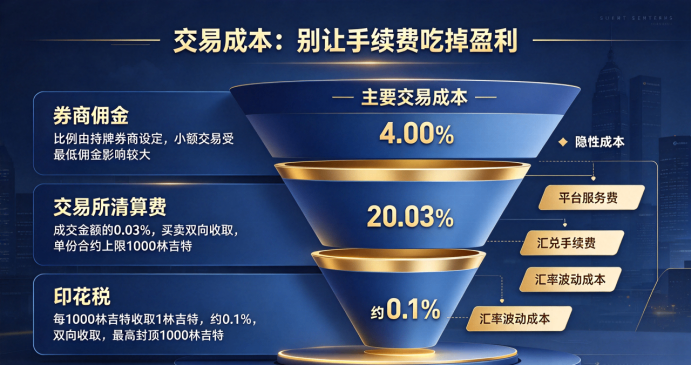
Many novice investors focus solely on stock price fluctuations while neglecting transaction costs; as a result, their profits are eroded by transaction fees after engaging in frequent short-term trading. When trading stocks on a stock exchange, the primary costs consist of three main components: brokerage commissions, exchange clearing fees, and stamp duty—both buying and selling transactions incur these fees.
First are brokerage commissions: the commission rates are set independently by each licensed brokerage firm; online brokerage firms typically charge lower commissions, whereas traditional brokerage firms often charge higher rates. A minimum commission threshold is generally applied; for small-value transactions, this minimum threshold can significantly increase the overall cost, making frequent small transactions less cost-effective. Second are exchange clearing fees, with a fee rate of 0.03% of the transaction value, payable by both the buyer and the seller; the cap per contract is 1,000 ringgit. Third is stamp duty, levied at 1 ringgit per every 1,000 ringgit of transaction value—approximately 0.1%—also payable by both parties, with a maximum cap of 1,000 ringgit per contract. These are statutory taxes imposed by the Malaysian government, and the same standard applies to all investors. Some brokerage firms may also charge platform service fees and foreign exchange handling fees; when overseas investors trade using foreign currencies to acquire ringgit, they must also bear the cost of foreign exchange conversion. These implicit costs should also be factored into the overall return calculation.
Beyond transaction costs, novice investors should be aware of several key risks in the market. The first is sector risk: the ACE market features a large number of low-priced penny stocks—whose share prices may be only a few cents—making them highly susceptible to speculation, characterized by poor liquidity and the potential for sharp price swings. Many overseas investors, attracted by these low prices, may purchase blindly, which can lead to substantial losses. The second risk is exchange rate risk: since the assets are denominated in Malaysian Ringgit, even if the stocks themselves generate profits, a significant depreciation of the Ringgit against the investor's home currency could result in the actual returns turning from positive to negative once the assets are converted back into the investor's domestic currency.
Under Malaysia's dividend regime, a single-tier tax system is applied: after a company pays corporate income tax, dividends distributed to shareholders are not subject to additional withholding tax at the corporate level. However, foreign investors must comply with applicable tax residency regulations, conduct proper tax planning, and pay close attention to exchange announcements regarding ex-dividend and ex-rights dates—specifically the ex-dividend date and the record date—to avoid the misconception that purchasing shares guarantees dividend receipt due to a misunderstanding of these critical timelines. Investors should also remain vigilant against various fraudulent investment schemes; the Securities and Market Commission (SFC) of Malaysia frequently exposes fake platforms impersonating the Malaysia Securities and Exchange Corporation (MSE) or brokerage firms. Investors are strongly advised to select only licensed brokers available on the official MSE website and steer clear of high-return investment scams. Additionally, overseas investors may face information asymmetry: many Malaysian listed companies disclose material information primarily in Malay, with limited English-language materials and even fewer Chinese-language disclosures. Consequently, accessing relevant information can be more challenging than in the domestic market; investors should avoid making blind trading decisions based solely on fragmented online information.
In summary, the Malaysian stock market operates under its own unique institutional framework. Key features—including the dual-account CDS custody system, T+0 trading coupled with T+2 settlement, specific price fluctuation limits, dual imposition of stamp duty and clearing fees, and the pronounced risk divergence between the Main Board and the ACE market—constitute fundamental knowledge that every novice investor must thoroughly master before entering the market. Many investors, eager to secure returns, skip the necessary study of these rules and directly adopt trading practices from other markets. Consequently, they often encounter pitfalls regarding trading units, settlement timelines, transaction costs, and sector-specific risks, ultimately incurring avoidable losses.
Being familiar with trading rules does not guarantee steady profits; such rules can only help us avoid elementary operational errors. The market itself, however, still entails multiple risks, including industry cycles, corporate performance, exchange rate fluctuations, and liquidity conditions. For novice investors, it is advisable to first thoroughly review the publicly available information of the exchange, start with modest capital, prioritize familiarizing oneself with high-liquidity stocks on the main board, avoid speculating on low-priced penny stocks, adopt a rational approach to dividend returns, and implement proper foreign exchange and tax planning. Overseas capital markets offer both opportunities and risks; only by fully mastering the underlying trading rules and cultivating a robust risk awareness can one explore the Malaysian stock market with greater composure.

 Home
 Message
 Phone